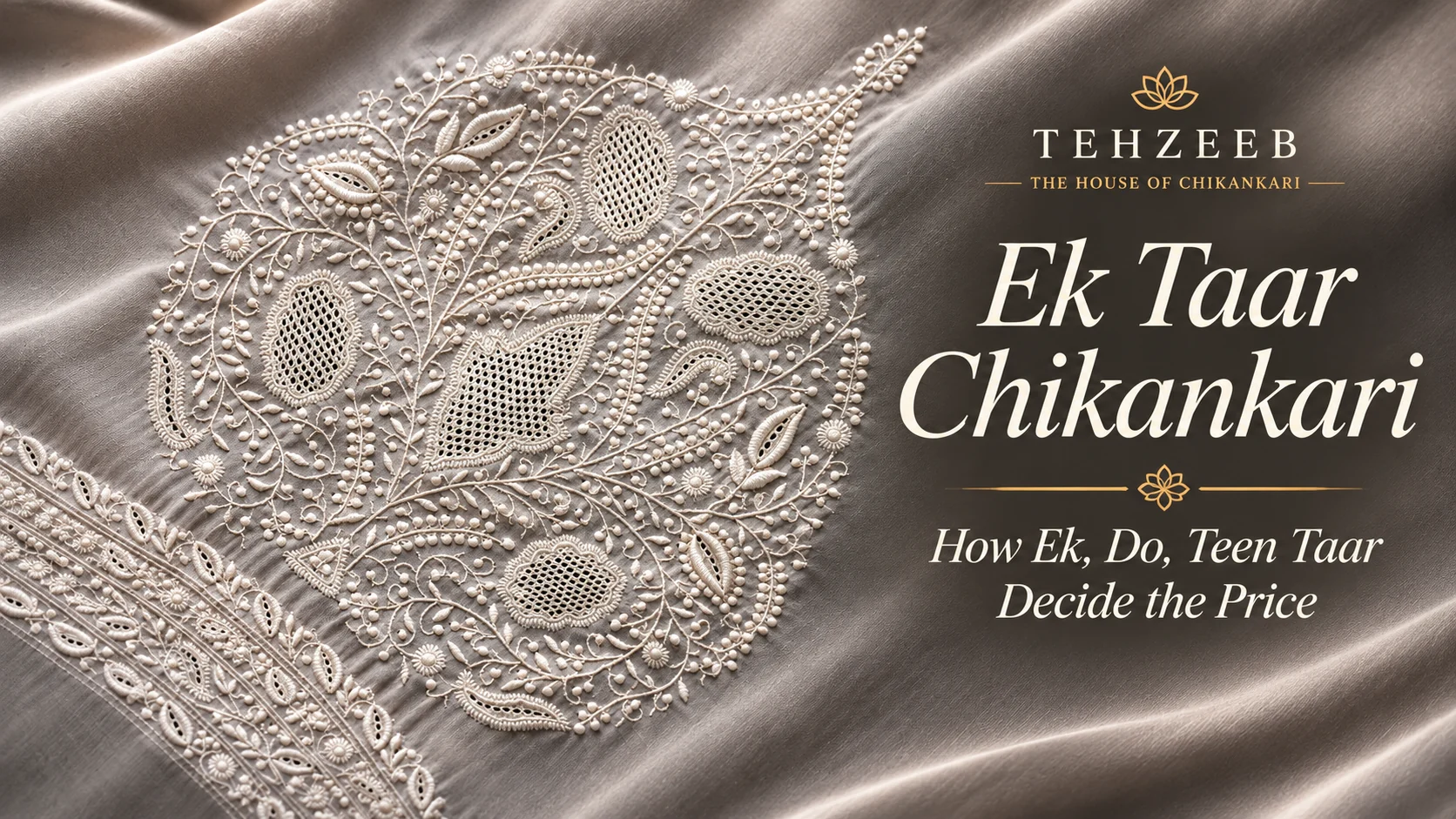
Ek taar chikankari is embroidery worked with a single strand of thread. Do taar uses two strands twisted together, teen taar three. That one word, taar, meaning thread, tells you more about a piece than its colour, its fabric or its label, because the thread count decides how fine the work is, how long it took and, in the end, what it costs.
In this guide
What ek taar chikankari means
Lucknowi chikankari has around thirty-two stitches, from the flat tepchi and the shadow-work bakhiya to the raised murri and phanda knots and the open jaali. Any of them can be worked in any thread count. The stitch is the alphabet; the thread is the handwriting. Ek taar is the finest handwriting there is: one strand, so thin that a single paisley can hold several hundred stitches.

Ek taar, do taar and teen taar compared
- Teen taar (three strands) is the everyday weight. The embroidery is bold, reads clearly from a distance and covers ground quickly. Most ready-to-wear chikankari kurtis are teen taar or heavier.
- Do taar (two strands) is finer and sits closer to the cloth. Motifs gain detail, shadow work looks softer, and the garment drapes with less stiffness.
- Ek taar (one strand) is the finest. Jaali work becomes almost transparent, and the embroidery feels like part of the fabric rather than something sitting on it.
Why ek taar chikankari costs more
Finer thread means more stitches to cover the same motif, and each stitch takes the same hand the same time. A paisley that needs forty teen taar stitches might need two hundred in ek taar. Across a saree, that difference is counted in months. Ek taar also forgives nothing: every tremor shows, so only the most experienced artisans work it, and their time costs more.
That is the honest answer to is chikankari expensive: machine-embroidered copies sold under the same name cost what a print costs, while a genuine ek taar ensemble costs what months of one skilled person's work costs. Both are called chikankari; only one of them is.

How to recognise ek taar chikankari
- Look at the back. Hand embroidery shows knots, thread ends and small irregularities on the reverse. Machine work is uniform, often with a loose chain of thread running between motifs.
- Count the stitches in one leaf. If you can count them easily, it is teen taar. If they blur into a surface, it is ek taar.
- Hold it to the light. Ek taar jaali, and above all haath jaali, where the artisan parts the threads of the cloth with the needle rather than cutting it, looks like lace. Cutwork copies look like holes.
- Feel the weight. Fine thread adds almost nothing; a heavily embroidered ek taar georgette still floats.
Where ek taar chikankari is worn
Because it is light and quiet, ek taar suits the pieces that are worn longest and looked at closest. On a saree it covers the pallu and border without weighing down the drape; see the Nakkashi ek taar saree or the ivory jaali pallu version. On an ek taar chikankari suit or anarkali it fills a yoke or a full panel. For brides it is the base layer of a lehenga, with mukaish or zardosi added as highlights rather than replacing the thread work. The full range is on the chikankari sarees page.
Caring for ek taar chikankari
Fine thread needs gentle handling rather than special treatment. Dry cleaning is safest for heavily worked silk and organza. Cotton and georgette pieces can be hand washed in cold water with a mild detergent; do not wring them, press the water out in a towel and dry them flat in the shade. Iron on the reverse at low heat with a cloth in between, so the embroidery keeps its raised texture. Store pieces folded in muslin rather than plastic, and refold them every few months so the creases do not settle into the same threads.
Ek taar chikankari at Tehzeeb
Tehzeeb's collections are ek taar and haath jaali by default, with do taar used where a design wants a slightly stronger line. Every piece is made to order, which is why the pages say enquire rather than add to cart: the thread count, the fabric and the motif are agreed with you before the first stitch. If you would like to see the difference in person, send us a message and we will share close-up photographs of the same motif in each thread. For the wider story of the craft, read our guide to authentic Lucknowi chikankari.
Questions about ek taar chikankari
What does ek taar mean in chikankari?
Ek taar means one thread. Ek taar chikankari is embroidered with a single strand, the finest thread count used in Lucknow, as opposed to do taar (two strands) and teen taar (three).
How long does an ek taar chikankari saree take?
Months rather than weeks. Because a single strand needs many more stitches to fill each motif, a fully worked ek taar saree typically takes several months of one artisan's time.
Can I order ek taar chikankari from the US, UK or Canada?
Yes. Tehzeeb ships worldwide from Lucknow. Measurements are taken by video or from a garment that fits you, we reply on WhatsApp across time zones, and the delivery time and any import duties for your country are confirmed before you order.
Is ek taar better than teen taar?
Finer, not better for every use. Ek taar gives the most delicate, lace-like result and suits occasion and bridal wear; teen taar is bolder and quicker, which makes it practical for everyday pieces.