
A chatta patti gharara is the most elaborate dress Lucknow makes: a farshi gharara, wide pleated trousers that sweep the floor, pieced from strips of coloured fabric before any embroidery begins. Worn with a short kurti and a long dupatta, it is the dress of the Awadhi bride, and one of the least understood garments outside the city.

In this guide
What makes a gharara a farshi
A gharara is gathered at the knee: the upper leg is fitted and the lower leg flares from a band called the gote, so the garment falls in heavy folds. In a farshi gharara the flare is long enough to trail on the floor (farsh), often by a hand's width or more, and the fabric is generous: a single pair can use well over ten metres. It is cut to be walked in slowly.
The farshi gharara is shared by Lucknow, Hyderabad and, across the border, Pakistan, where it remains a favourite for the nikah and the mehndi; the Pakistani version is often worn with a longer shirt, the Lucknowi one with a kurti that ends at the hip. That is why the same set is ordered for weddings in Lucknow and Karachi as often as in London, New Jersey and Toronto.
What chatta patti gharara means
Chatta patti, also written chattapatti or chatapati, is patchwork: narrow strips (patti) of silk, brocade or velvet in different colours, joined edge to edge into a pattern, with the seams covered by gota or embroidery. The technique belongs to the Nawabi era, when offcuts of expensive brocade were too precious to discard and were pieced into something grander than the cloth they came from. A chatta patti set is therefore a farshi gharara built from these strips: every pleat carries a change of colour.

How a chatta patti gharara is made
- Cutting. The strips are cut on grain and matched in weight, so the flare falls evenly and no panel pulls.
- Piecing. They are joined into the colour pattern and sewn so that it aligns across every pleat; a single gharara can hold several hundred joins.
- Covering the seams. Gota, zardosi or chikankari is worked over the joins, which is where most of the visible embroidery sits.
- The gote. The knee band is embroidered last and most heavily, because it is where the eye lands when the gharara moves.
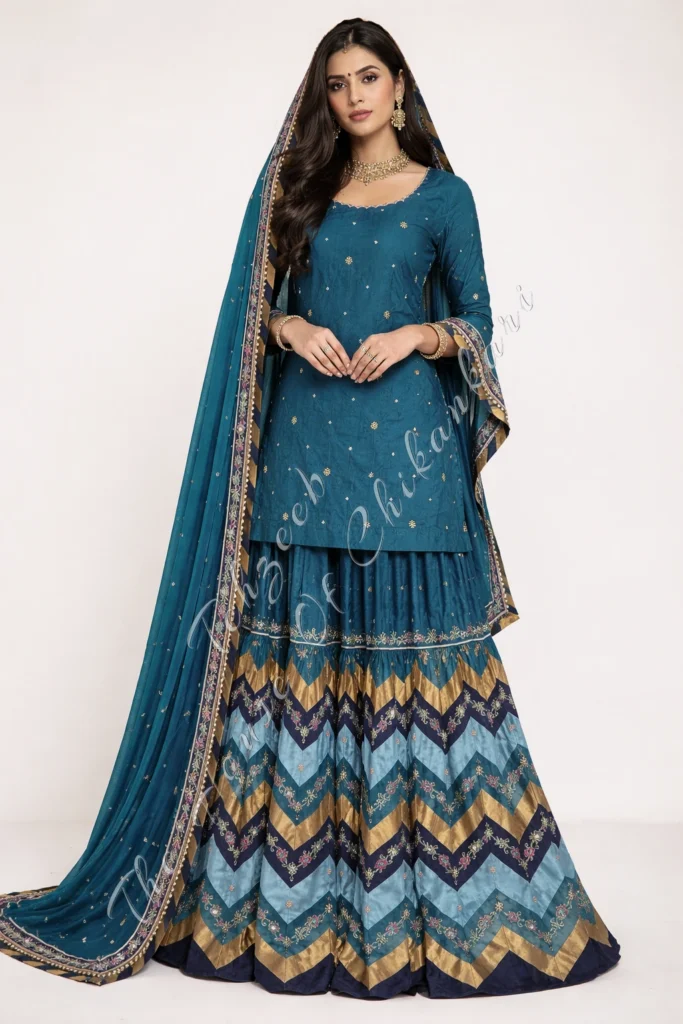
Chatta patti gharara designs: colours and embroidery
Because the strips do the colour work, the embroidery on such a set is usually kept to the seams, the gote and the hem. Red and gold is the classic bridal pairing; ivory with rose or mint reads softer and suits day functions; deep green and wine look rich in winter. A plain farshi gharara without patchwork relies on embroidery instead, often chikankari with mukaish highlights, and can feel lighter and more contemporary.
Walking and sitting in a farshi gharara
The trail is part of the look, so it is worth practising. Lucknow brides traditionally lift the front of the gharara slightly with one hand when walking, which keeps the hem clean and makes the pleats swing. Decide on your shoes before the final fitting, because the length of the trail is set against the heel height. When sitting, the flare is spread to the sides rather than gathered underneath, which is also how the embroidery on the gote shows best in photographs.
Ordering a bridal chatta patti gharara
- Decide the set. A farshi gharara is worn with a kurti that ends at the hip and a dupatta of at least two and a half metres, so the full set is three pieces embroidered to match.
- Choose the colour story first. Chatta patti depends on the contrast between strips; red and gold reads very differently from ivory and rose.
- Allow time. Piecing, embroidery and finishing on a bridal set run to months, not weeks.
- Ask about weight. Heavily worked gharara are heavy; the lining, the gote construction and the dupatta edge all affect how it wears over a long evening.
Chatta patti gharara at Tehzeeb
Tehzeeb makes both pure farshi gharara and chatta patti sets, hand embroidered in Lucknow in the Awadhi tradition, each one cut and pieced for its wearer; see Mehr-un-Nisa or browse all of them on the farshi and chatta patti gharara page. Send us the occasion, the colour and the date through the contact page or WhatsApp and we will design one around them. For styling the set, read how to style chikankari for weddings.
Questions about the chatta patti gharara
What is the difference between a gharara and a sharara?
A gharara is fitted to the knee and flares from a band below it; a sharara flares from the waist. A farshi gharara is a gharara long enough to trail on the floor.
Is a chatta patti gharara only for brides?
No. Brides wear the heaviest sets, but lighter chatta patti sets in softer colours are worn by the bride's family and guests at nikah, mehndi and walima functions.
How far ahead should a bridal gharara be ordered?
Several months. Cutting, piecing, embroidery and finishing all take time, so start as soon as the date and colours are fixed.
Can a chatta patti gharara be ordered from the UK, US or Canada?
Yes. Sets are made in Lucknow and shipped worldwide; measurements are taken by video, the fitting happens on a video call, and the transit time and import duties for your country are confirmed before work begins. Allow extra weeks for shipping when you set the date.
What is worn with a farshi gharara?
A short kurti that ends at the hip, often embroidered to match the gote, and a long dupatta of two and a half metres or more, draped over the head for the nikah and over the arm afterwards.